
When walking around an RF laboratory, it’s almost impossible to avoid seeing the same number everywhere: 50Ω.
Vector network analyzers are marked 50Ω, spectrum analyzer input ports are labeled 50Ω, signal source output impedances read 50Ω, and interfaces on coaxial cables, fixed attenuators, power dividers, and numerous RF modules all cite 50Ω.
This naturally raises a reasonable question: “Why specifically 50Ω? Why not 40Ω, 60Ω, or the also common 75Ω?”
This choice is neither a historical habit of a particular organization nor the subjective decision of a company. In essence, 50Ω is the result of long-term engineering compromises in RF design, balancing power handling, transmission loss, manufacturability, and standardized interoperability. It is not the only “correct” number dictated by physics, but it is undoubtedly one of the most important engineering conventions in RF testing and communications equipment.
Truly understanding 50Ω is less about memorizing a historical decision and more about realizing that if your system is consistently built around 50Ω, instruments, cables, devices, test fixtures, and S-parameter data can all communicate using the same engineering language.
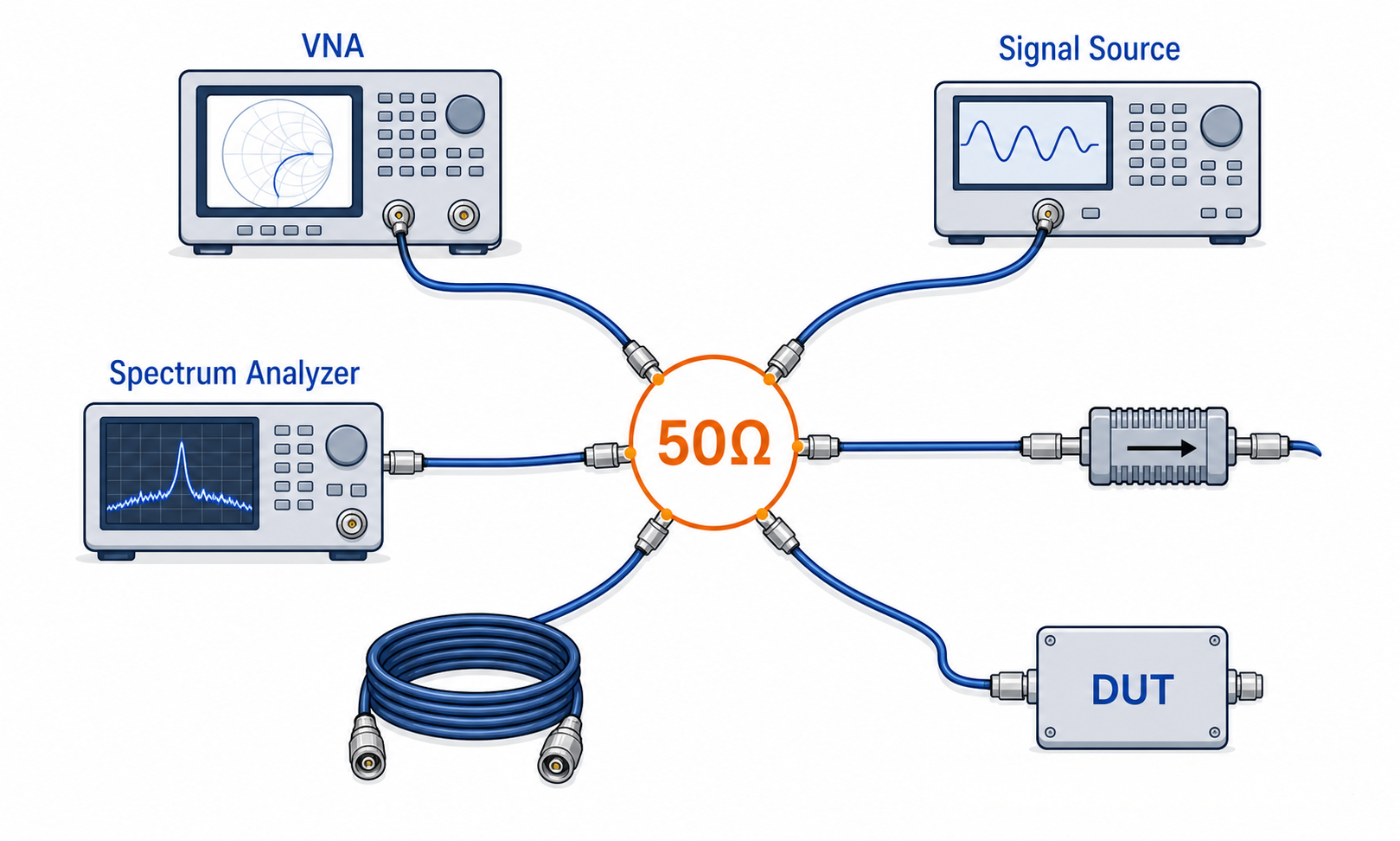
What Does This Specification Describe?
In the context of RF systems, 50Ω usually does not mean that a 50Ω resistor is physically installed and constantly dissipating power. Rather, it indicates that the system’s reference impedance is defined as 50Ω.
It addresses a class of interface questions: when an RF signal propagates along a cable, connector, PCB trace, or instrument port, what equivalent impedance does it “expect” to see?
If all impedances along the path are 50Ω, propagation is smooth and reflections are minimal. Conversely, if a segment suddenly presents 20Ω, 100Ω, an open circuit, or a short, reflections occur, S11 worsens, power transfer efficiency decreases, and in severe cases, standing waves, ripples, or system instability may arise.
Thus, the core meaning of 50Ω is not that the number has mystical properties, but that using a uniform impedance reference across the RF chain allows power transfer, measurement readings, and device specifications to be mutually compatible.
Understanding this is easier when looking at the two extremes of coaxial lines:
Lower impedance favors higher power handling.
Low impedance allows greater current for the same voltage and is naturally better for high-power transmission.
Higher impedance can yield lower transmission loss under certain conditions.
For air-dielectric coaxial lines, the minimum attenuation point occurs around 70–80Ω—explaining why 75Ω systems are widely used in TV, video, and broadcast reception.
50Ω sits roughly between these needs: it offers decent power capacity, acceptable transmission loss, and manufacturability into stable coaxial structures. This balance is why 50Ω became the mainstream choice in RF testing, radar, communications, and microwave engineering.
S-parameter measurement and interpretation require a clear reference impedance. In almost all RF instruments and datasheets, this reference is 50Ω.
For example, an S11 = -20 dB does not indicate absolute perfection but means the input reflection is relatively low in a 50Ω system. Similarly, S21 = 12 dB typically indicates that, with 50Ω source and load impedance, the transmission gain from port 1 to port 2 is 12 dB. These 50Ω conditions are critical: if your actual system is not 50Ω, measured device performance may deviate significantly.
Consider an amplifier datasheet:
Gain = 15 dB
Input Return Loss = 18 dB
Output Return Loss = 12 dB
Condition: 50Ω system
This data explicitly indicates that measurements were taken in a 50Ω environment. Connecting the device directly to a mismatched antenna, filter, or homemade fixture can result in gain and stability differing from the datasheet. Conversely, if the entire chain maintains 50Ω, S-parameters are highly engineer-comparable—cable loss, attenuator insertion loss, filter insertion loss, and amplifier gain can be added sequentially to complete a link budget.
This is the real value of 50Ω: it enables RF modules to connect like building blocks and provides a unified reference for measurement.
How to Interpret Related Curves
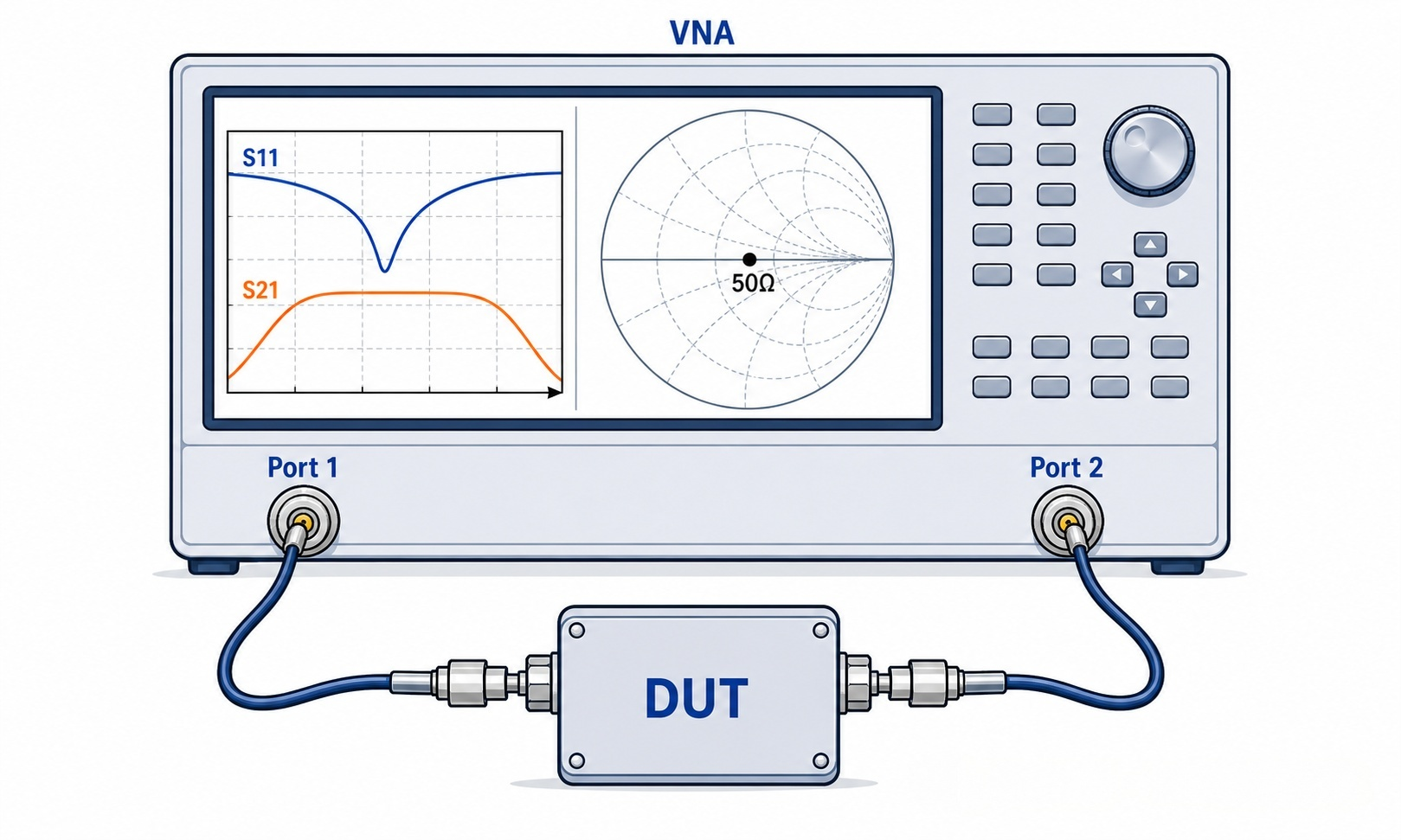
To determine if a device suits a 50Ω system, typically three types of curves are examined:
1.observe S11 and S22.
S11 reflects the matching degree of the input port with respect to 50Ω, and S22 corresponds to the output port. Common engineering judgments are as follows:
indicator | meaning | Effect on 50 Ω systems |
S11 lower | Low input reflection | The signal source or front stage sees a load closer to 50 ohms. |
S22 lower | Low output reflection | The subsequent stage or load is easier to receive power |
S11/S22 is obviously high | Port deviation 50Ω | May introduce power errors, ripple, or stability issues |
2.pay attention to S21.
In a 50 Ω system, the S21 can be used directly for the link budget. For example:
Signal source output -10 dBm
Cable loss 1 dB
Filter insertion loss 2 dB
Amplifier gain 15 dB
Then the output power is -10 - 1 - 2 + 15 = 2 dBm.
The premise of this calculation is that the port matching of each stage is not seriously deviated. If the matching is poor, the reflection will affect the actual power transmission, and the simple dB addition will become unreliable.
3.look at the Smith chart
The center point of the Smith chart usually corresponds to 50 ohms. The closer the trajectory of the device port is to the center, the closer the impedance is to 50 ohms; if the trajectory is significantly off-center, the impedance changes sharply with frequency.
When consulting datasheets, pay attention to:
Test condition: 50Ω.
Most RF devices (amplifiers, filters, mixers, dividers, couplers, attenuators, switches) report typical specifications in a 50Ω system; S-parameter curves use 50Ω as reference.
Internal matching of ports.
Some modules state Input / Output impedance: 50Ω (internally matched), while others say External matching required, meaning pins must be matched to 50Ω using inductors, capacitors, microstrip lines, or baluns.
Operating frequency range.
A nominal 50Ω device may not maintain good matching across all frequencies; datasheets specify bands (e.g., 700–2700 MHz, 2.4–2.5 GHz).
Typical, min, max, and temperature.
50Ω matching is affected by process variation, temperature, bias, and signal level. Don’t rely solely on typical curves.
Evaluation board schematics.
For chips not inherently 50Ω, EVB matching networks transform the device to 50Ω. Ignoring them may yield unexpected results.
50Ω is optimal in all cases.
It is a practical compromise. TV/video uses 75Ω; high-speed differential interfaces use 90–100Ω. Antenna or internal chip optimum impedance may differ.
50Ω Connectors prevent reflections.
Nominal 50Ω does not equal perfect match. Connectors, PCB traces, packaging, and frequency edges introduce discontinuities.
All 50Ω cables are interchangeable.
Even at 50Ω, cables differ in loss, phase stability, bending sensitivity, power handling, and frequency limit.
50Ω and 75Ω are close enough.
Mixing in precise power tests, S-parameters, or broadband links introduces reflections and reading errors.
Multimeter can verify 50Ω matching.
Multimeters measure DC or low frequency resistance; RF matching depends on high-frequency characteristics.
Select devices for 50Ω systems. Prioritize modules with 50Ω S-parameters for smoother link budgeting and testing.
For chips, check external matching. LNA, PA, mixer, or transceiver optimum matching may not equal 50Ω; consult design docs and matching networks.
Verify 50Ω test chain before measurements:
Calibrate VNA.
Connect 50Ω standard load.
Confirm S11 sufficiently low (e.g., < -35 dB).
Connect DUT.
Account for matching in link budgets. dB can be added sequentially only if matching is good; high S11/S22 introduces standing waves and power uncertainty.
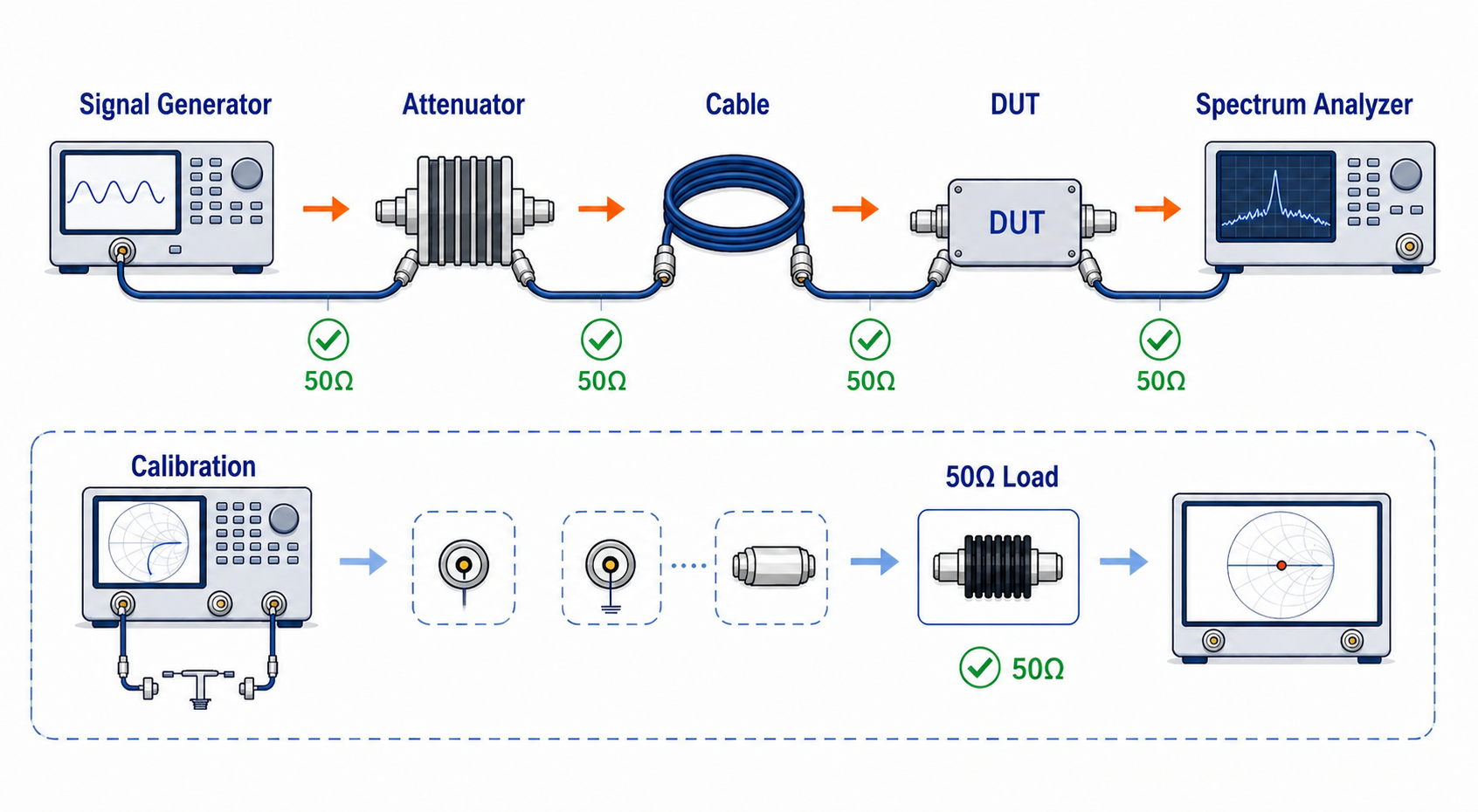
50Ω is an interface standard, not a design endpoint.
The goal is port compatibility for power exchange and testing. Internal chip nodes, matching networks, and antenna feed points may differ from 50Ω.
When seeing 50Ω:
Are instruments, cables, connectors, and DUT all designed for 50Ω?
Are datasheet S-parameters based on 50Ω?
Are S11/S22 sufficiently ideal within operating band?
Has calibration plane been moved to the port of interest?
Are 50Ω/75Ω, single-ended/differential, chip bare/ module ports mixed?
If answered confidently, 50Ω becomes a friend: a unified RF interface, comparable measurements, and shared design reference. Otherwise, it’s merely a familiar number—visually reassuring, but prone to errors.
Professional Communication Products
ZHENGZHOU LeHeng ELECTRONIC TECHNOLOGY CO.,LTD
Tel:86-371-60911368
Email:info@global-antenna.com
Website:https://www.global-antenna.com/
Contact: Diana Xie
Phone: 86-15815571536
E-mail: sales@global-antenna.com
Whatsapp:8615815571536
Add: Room826, Floor 8,BLDG 13, University Science Park(East), Zhengzhou City, P.R.Henan, China.Zip Code: 450000
